
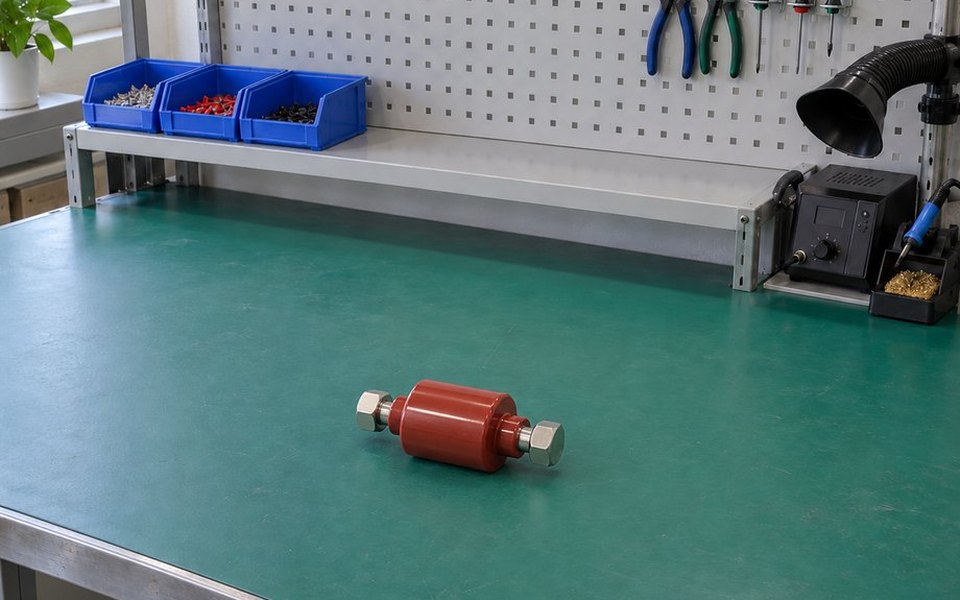
Engineering guide on protecting pipeline monolithic insulating joints (IJs) and flanges from lightning flashover and fault surges in Zone 1/Zone 2 hazardous areas using IP67 arc-encapsulated isolating spark gaps (50 kA/100 kA, 10/350 μs), covering low-inductance lead routing and junction box integration.
At pipeline block valve stations, compressor yard tie-ins, and transitions between buried cathodically protected lines and grounded above-ground piping, monolithic insulating joints (IJs) and insulating flanges prevent DC cathodic protection (CP) current from draining into station earthing grids. However, during direct or induced lightning strokes and power-system ground potential rise (GPR) faults, transient potentials across an unshunted joint can easily exceed its internal dielectric withstand, causing permanent carbonized short-circuits and coating damage.
1. Why Zone 1 & Zone 2 Facilities Require Arc-Encapsulated IP67 Spark Gaps
Conventional open-air spark gaps emit external arcs during discharge and cannot be deployed in hazardous gas environments. Engineered in compliance with IEC 60079-1, EN 50162, and NACE SP0177, JUDUN JD-ISG Series Explosion-Proof Isolating Spark Gaps house an arc-encapsulated discharge module inside a weatherproof IP67 Heavy-Duty Arc-Encapsulated body:
- Zero Standby CP Drain: Under normal pipeline potentials, insulation resistance remains
≥ 100 MΩ (@ 100V DC), preserving 100% of CP current isolation across the joint; - Nanosecond Overvoltage Clamping: Once surge voltage reaches the sparkover threshold (
≤ 250 V – 500 V), the gap fires almost instantaneously to equalize both pipe sides, then self-extinguishes cleanly after the surge passes; - Class H 10/350 μs Impulse Capacity: Available in
50 kA (JD-ISG-50Ex)and100 kA (JD-ISG-100Ex)heavy-duty 10/350 μs lightning test ratings for exposed transmission corridors.
2. Eliminating Lead Inductance: The #1 Field Installation Mistake
Even when a 100 kA spark gap is specified, overly long or coiled connecting leads can still allow an insulating joint to flash over. Under steep lightning current rise rates (di/dt), standard copper cable exhibits roughly 1 μH/m of inductance—meaning a 2-meter cable loop can develop several kilovolts of inductive drop before current diverts through the spark gap.
- Above-Ground Flange & Valve Installations: Bolt the spark gap mounting bracket directly adjacent to the insulating joint lugs, keeping leads straight and short (ideally
≤ 0.3 m – 0.5 mper leg) using≥ 16 mm² – 25 mm²copper conductor or flat low-inductance copper strap; - Buried Insulating Joints: Route short, untwisted risers vertically into a dedicated JUDUN Insulating Joint Protector Junction Box (JD-IJB-ISG) positioned directly over the buried joint, integrating copper busbars and removable links for periodic joint-isolation integrity testing.
3. Choosing Between ISG, Ex-SSD, and Zinc Grounding Cells
Select an Isolating Spark Gap (JD-ISG) when the primary threat is transient lightning or brief fault overvoltage with negligible steady-state AC voltage. Where the pipeline parallels high-voltage overhead transmission lines and carries continuous induced AC current, specify a Flameproof Solid-State Decoupler (Ex-SSD) rated for 45A – 80A rms continuous AC conduction. For remote buried joints without above-ground enclosures, a pre-packaged Zinc Grounding Cell provides passive surge relief. All JUDUN mitigation hardware undergoes batch dielectric and impulse verification under our certified quality system (ISO 9001 / ISO 14001 / ISO 45001), with bilingual laser nameplates and EPC submittal drawings ready for international projects.